Showing posts with label Seeds. Show all posts

Friday, October 17, 2014

Coriander Harvest Time


It's only recently that I started using coriander in my cooking and I've found out I love the flavor.  So this year I decided to harvest my own.

Coriander is the seed of the cilantro plant, Coriandrum sativum.  Lots of people don't know that they come from the same plant, and in the US we tend to call the green leaves cilantro and the seed of the plant coriander.  In England the leaves are called coriander also so if you have a recipe make sure you know whether it is referring to the leaf or seed.

So on this beautiful Fall day with the trees in all their glory I basked in the glow of the red, orange and gold shining on the garden and harvested the coriander.

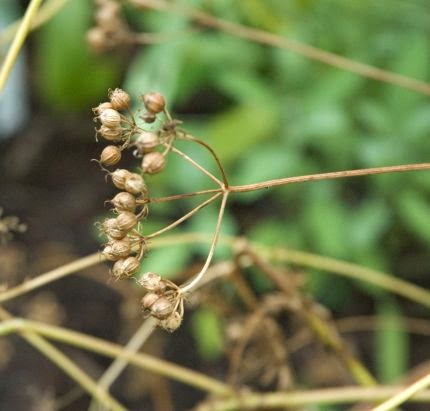
In order to have the seeds you need to let some of your cilantro bolt and go to seed.  That's not difficult, and if you're like me the cilantro seems to bolt when I'm not looking!  So let a few plants flower and then the flowers will turn to seeds.  You want to make sure that the seeds are brown, as the picture above, not green when you harvest them.  The green seeds will be bitter and also contain too much moisture to store for any length of time successfully.

I like the paper bag method of harvesting seeds and use the same method for coriander that I do with dill.  Once the seeds are brown, I cut the stems and place them seeds and all in a brown paper sandwich bag.  You can use a larger brown shopping bag if you like or a plastic bag, whatever works for you.  I then shake the stems and the seeds pretty much just fall off.  For those that don't, I just rub them on the stem and they fall off.

Coriander seeds are small and easily drop all over the place.  I like to shake the stem just a little bit over the garden when I cut it so the seeds will self-sow for more cilantro plants next year.  The harvesting can be a bit messy so who knows where the cilantro will show up?

I also save a few seeds for planting next year, just in case the self-sowing doesn't happen but I usually find cilantro and dill popping up all over the garden in the Spring which I love.

So plan to harvest your own coriander next year!

Wednesday, April 7, 2010

Seeds 101

I don't know how many people come into the store, look at the Seeds of Change seed rack and state that they can't start plants from seed. I tell them they can and they just shake their head, having given up after attempts and ending with non-germinated seed or seedlings that have died. So I'm on a mission this year to get those seeds going.

Last month I did a free seed starting demonstration at the store, which was well attended and everyone went home with a peat pot they had planted with calendula seed. I'm always amazed by calendula seed, it doesn't look like a seed at all, more like a dried up curled little worm. That this grows into a good size plant with those beautiful flowers is rather amazing. I also have some that I found when cleaning up the garden so planted them and hope to see some reseeding this year of the calendula. But back to seed starting...

While starting seeds isn't difficult, there are some things that ensure a good healthy seedling. The first thing I talked about was soil...a good soil starting mix is needed, not your soil from the garden or even a regular potting soil. I sometimes make my own mix with peat, but found a nice organic seed starting mix this year at my local organic garden supply store that seems to be working very well so far.

Second is light, seedlings need direct light and a lot of it. A good south facing sunny window is great. Since I don't have that, I use grow lights. There is all sort of discussion about types of light to use, but I've found a regular flourescent light works fine, for 12-14 hours a day.

Seedlings also need heat, and I keep mine protected against drafts. And although my grow stand is by a window, there is baseboard heat all along the wall, giving warmth from underneath.

One of the mistakes I find people often make is starting their seeds too early. Seed packets have a wealth of information, including how long it will take the plant to germinate and grow. I've learned not to start most of my seeds until March to avoid plants ready to go in the garden way before their planting time.

Then of course there is water. Seeds do not like to be dry, and are very unforgiving if not watered. I keep my seedlings consistently moist (not necessarily wet), watering several times a day if necessary. Yes this is a bit time consuming and needs to be paid attention, but I get so excited watching the seeds germinate and the seedlings grow that I check on them several times a day just for the fun of it anyways.

I fertilize with an weak strength organic seaweed and fish emulsion while their growing, which was also included in my soil mix along with some other natural nutrients.

Here are a few of my current seedlings, cucumbers on the left and zucchini just opening...


As the seedlings are nearing time to go into the garden, they need to gradually become acclimated to the weather outdoors, a process called "hardening off". There is nothing more discouraging than spending all that time growing a seedling and then having it die of shock when it is placed in the garden. I start by opening the window behind my plants for an hour a day and then gradually longer so they get used to the wind and small breezes. I then bring them outdoors to a protected area for more wind and then gradually into the sunlight acclimate to the sun. I do this over a week or two, not a long time but it really does help them become strong plants in the garden.

Or instead of doing all this, seeds can be directly planted in the garden and some prefer to be. Again, the seed package will tell which seeds start best in which manner but I find myself starting more plants directly in the garden every year. Make sure they are kept watered and I use HotKaps to protect the delicate seedlings from heavy rain or wind and also from insects.

So there's no excuse not to start plants from seed. It is economical and provides for a lot of choice in plants which may not be available otherwise. And just for the sheer awe that a small seed can become a plant to nourish our bodies and souls is reason itself. So happy seed starting!

Tuesday, February 2, 2010

Seeds, Glorious Seeds

Sometimes I just love snowstorms. I started this blog a week ago, but have been too busy to sit down and finish it. But snow days make me stop running around, stay in and I finally have some time to get some things done. Like this blog! And I find the garden breathtaking in the snow. I leave some echinacea heads purposely for winter interest (and the birds) and the hawthorn tree, fence and woods all look lovely covered with snow. Sitting by the fire, gazing at the snow covered garden with the snow falling is very peaceful and calming.

But this blog was about seeds. I put in the store seed order last week, a bit late (I left all my order info at home by mistake when I went to Florida) but in plenty of time for starting indoors. It's always a dilema - what to buy, how many, and trying to predict what people will want to grow this year. On the upside, it's wonderful to be able to order freely not having to think about what will fit in my garden or how many seedlings can I fit under the grow lights. For the store, I can buy everything I want. On the downside, it's hard to know what will sell and to make sure not to have too many left at the end of the season (which become my personal stash for next year).
But there are limits to how much I can buy, so I have to make the tough decision such as what types of basil (there are so many) and why didn't people seem interested in purple basil last year? It's so beautiful in the garden, delicious and makes a great herb vinegar in a beautiful red color. I like to have different things along with the usual parsley, cilantro, etc. so I'm trying a purple throated mullein this year and a Hopi ceremonial tobacco. Will others think these sound as interesting to try in the garden as me? Sure hope so!

I started selling more vegetable seeds last year and they were very popular. I primarily stock the heirloom and rarer types. I get all my seeds from Seeds of Change they are certified organic, well packaged and I appreciate the company's efforts to preserve biodiversity and support sustainable organic agriculture. And if people don't buy all these great heirloom seeds, they won't keep offering them I'm sure so I see it as my little part in keeping these alive.

So what did I order this year? Several bush beans - Jacob's cattle, a traditional heirloom and Tendergreen, another heirloom with purple specks that is purported to be "a great mainstay for the home garden". The usual rainbow colored chards, a rare medicinal burdock, Takinogawa Gobo, and Shiraz Tall Top beets with great tops and roots. How to pick among so many cucumbers? When in doubt, I pick what I would like to have in my garden (and will have) and picked a Lemon cucumber, Satsuki Madori, a rare Asian variety with few seeds and Smart Pickle, an early maturing pickling cuke. Same with tomatoes, so many choices so I picked a few heirloom cherries and slicing tomatoes. I rounded it out with some pumpkins, spinach, squash, kale, peas, watermelon, peppers, chicory and eggplant. A good selection of greens with lettuces, arugula, komatsuna, mizuna and mesclun mix rounded out the veggies.

And then there's the flowers. I stick to the edibles pretty much with a good selection of nasturiums, including a new Peach Melba which looks so pretty in the picture, an edible sunflower and lemon and tangerine gem marigolds. Calendula and foxglove round out the flowers with one of my old fashioned favorites, Love Lies Bleeding.

So I'm anxiously waiting for them to arrive and get some started. I try not to start my seeds too early and am already feeling the itch to get some going. But I'm holding back and getting my supplies all set. How many times have I had seedings too large for their little pots ready to go in the garden in April? One too many so I have learned to wait and work on the garden layout for the year. Maybe the topic of the next blog!