Saturday, June 19, 2010

Dr Emoto's Prayer for the Gulf

This is not my usual garden blog, so please skip it if that's what you're looking for. But water is an intregal part of our gardens, our lives and our earth and I wanted to put this out there to as many people as I could.

I recently received this prayer to the Gulf that was written by Dr. Masaru Emoto. If you are not familiar with the work of Dr. Emoto, he is an author, scientist and humanitarian whose work with water was highlighted in the movie "What the Bleep Do we Know".

I won't go into the politics, blame, and horror of this current disaster. I am just sad. So I was glad to see this simple prayer, that says it all....

"I send the energy of love and gratitude to the water and all the living creatures in the Gulf of Mexico and its surroundings.

To the whales, dolphins, pelicans, fish, shellfish, plankton, coral, algae, and all living creatures...

I am sorry.
Please forgive me.
Thank you.
I love you."

I am passing this along so if you are willing to participate in this prayer, set an intention of love and healing to the Gulf and repeat it as often as you like.

Tuesday, June 15, 2010

Strawberries in New England

I've decided it's time to stop with the garden envy from all the Blotanical posts. I read about people picking tomatoes and potatoes, harvesting beans and peas, visiting beautiful gardens and posting all these gorgeous pictures. I feel left behind and as if I will never catch up. But no more...

I live in a beautiful part of the world, which while cold much of the time, does have breathtaking seasons. And today is one of those beautiful June days when you wouldn't want to be anywhere else. Sunny, temps in the 70's, a slight breeze and the strawberries in full, lush bloom.

I don't grow strawberries myself, but like to pick them at a local farm the next town over. Indian Head Farm (www.Indianheadfarm.com) is a small, family farm that is quiet and peaceful when picking in comparison to the larger commercial operation down the street from me, which seems to always have lots of screaming children. Not my choice for a relaxing strawberry picking morning.
I had a million other things to do this morning, but the strawberry season is relatively short and decided this was the morning. How many did I pick? Not sure, I filled 2 baskets and came home to make Strawberry Jam. I used about 14 cups for the jam and have about 8 pounds left, so I guess I picked alot!
Here's the jam, the church fair is coming up this Fall and I always make some extra for that. Only 2 or 3 of us that make jams and jellies anymore, too bad. Easy and fun to make and it is always a big seller. But back to strawberries...

I may make more jam, but I wanted plenty left to snack on and eat fresh. Is there anything as wonderful as a fresh, juicy strawberry? Last night DH (on good days Dear Husband, on other days something not so nice) and I enjoyed some leftover lemon balm infused panna cotta I had made for my herbal apprentice class Sunday with strawberries on top. Ah, strawberries and cream, what a heavenly combination.

So I am feeling better, and so what if the garden isn't all planted yet, the weeds are growing, and I'm just harvesting some peas but everything else is a long ways away from harvest, that is just fine. All is as it should be today and I'm content and eating strawberries.


Saturday, May 29, 2010

Angelica Guiness Book of World Records?

So is there a category in the Guiness Book of World Records for the largest Angelica plant? If so, I think I should enter.

I've never quite understood the fascination for big vegetables. I look at the gimongous (wicked big) pumpkins and baseball bat size zuchini and don't really get it. Yes, there is some kind of morbid fascination with a 400 or 500 pound vegetable, but to spend all season nurturing some behemoth and then try and cart it off to the state fair for a ribbon seems a bit odd to me.

But having said that, I have a monster angelica (Angelica archangelica) growing and think it deserves some sort of blue ribbon in the monster plant world.

Angelica is known to grow large, and often reaches 6 feet, but mine is close to 7 feet and it is only the end of May. Known as an old medicinal herb to stimulate the immune system, it also has an anesthetic quality and the seeds and roots are often used with wormwood in making absinthe and the seeds are an ingredient in vermouth and chartreuse. I love the way the flowers seem to burst out of alien like pods that grow on the stems, fascinating to watch and a wonderful addition to the garden for its scent and amazing presence.

But back to the giant in the yard...I rescued this plant from some leftover plants at the store last year. It had overwintered outside in a pot and barely looked alive last Spring. Never being able to throw away a plant that has even a little life in it, I brought it home and planted it in my new garden, which had plenty of space to fill. It responded beautifully and I had a large, 5 foot plant last year which was healthy and strong but didn't flower. Wondering if it would come back this year, didn't I see it emerge in early Spring and by the end of April was as large as it was last year. Here it is in early Spring at the back left hand side of the picture along the fence...


Would it bloom this year? By the end of May it is now covered in over a dozen flower heads, just popping out all over. A recent hail storm knocked down some of them and I thought of trying to stake it, but I don't have anything near tall enough to stake it to.

Although commonly known as a biennial, angelica is really a short-lived perennial and dies after it's flowering year, which means this plant will die after this year. That makes me rather sad, so I'm trying to enjoy the plant in all its majesty this year. Candied angelica stem is a Victorian classic, and there are all sorts of recipes for using the roots, leaves, and seeds which I think I will try this summer in honor of this incredible plant.

Has anyone ever cooked or used their angelica? If so, please feel free to post your experiences or recipes. And can anyone else vie for the blue ribbon prize for biggest angelica this year? I'm awarding it to myself until I see a bigger one!

Heirloom Tomatoes

There is a lot written about heirloom tomatoes but it is also a topic I get a lot of questions from at the store. This is a reprint of an article I had in last year's store newsletter that I thought would be good to repeat on the blog, as well as give it a place to stay for reference.

There are some varying descriptions of the term heirloom as it applies to plants, but generally speaking it means a variety that is over 50 years old (although some people say they should be over 100 years old) and is open-pollinated, which means the seeds can be saved and the resulting plant will be the same as the parent (as opposed to hybrids where there are different parents and the seeds do not "breed true"). So why does this matter? As Lawrence Davis-Holler explains in his book The Tomato Festival Cookbook, the hybridization after World War II to develop tomatoes that could be picked early and shipped to grocery stores without bruising (thus thicker skins) came at a cost of flavor.

The interest in heirloom tomatoes became more focused with the creation of Seed Savers Exchange in 1975 and over the years farmers have been growing more heirlooms and selling them at farmers markets and restaurants.

And you can grow your own and I would suggest you put in at least a few heirlooms with your other tomatoes, if not just grow heirlooms. Heirloom tomatoes come in almost every size and shape imaginable and that is one of the fun things about growing them. Brandywine can grow up to several pounds and is considered by many to be the best tasting tomato. Colors of heirloom tomatoes can vary from red and pink to black, purple, yellow and green. I love Striped Zebra (green with stripes) and Cherokee Purple and other great named ones are Black Prince, Great White (which is actually yellow) and Striped Cavern to name a few. Many of the heirloom tomatoes have great stories, and whole articles can be written on any one of them, making them even more interesting to grow.

Green Striped Zebra

Do you have a favorite heirloom? Post your favorite here.

Sunday, May 9, 2010

Spring Garden Highlights

I'm a bit late posting the Spring photos of the garden. I actually started this post about 3 weeks ago, but am just getting around to finishing it up. It still takes me an awful long time to get the pictures arranged, and they still don't come out how I would like. Oh well....

It's been a beautiful, extended Spring with bouts of warm weather and rain that made the garden pop. I can't remember a Spring in recent years that lasted so long and the colors on the Spring shrubs and plants are just spectacular.

Daffodils and bleeding heart, two favorites.. Love the delicate flowers of the pulmonaria

Since the garden was just planted last Fall, I was anxious to see what would survive the winter, how the bulbs that were planted would look and if things would start filling in. I was pleased on all accounts, and just need to get some mulch down and I think the gardens by the steps will be all done. I did lose my espaliered apple tree. It fruited for the first time last summer and I was so excited. Then something ate the bark all around the base over the winter, and it is dead, dead, dead. So disappointing and I'm having trouble finding a new one. But everything else is looking good and here are some random shots of the new garden this Spring, enjoy!

Saturday, May 1, 2010

Plant Swapping

Gardeners are some of the most generous people in the world. Who else just loves to give their plants away? You know someone is an avid gardener when you visit their garden and they say, "let me give you some", and before you know it they have pulled out a trowel and pot and you are loaded with new things for the garden.

I recently visited the garden of a fellow blogger, Layanne from Ledge and Garden, (Layanne is one of the "Garden Guys" on 96.9FM on Sunday mornings). She had stopped by the store on a trip to Tower Hill Botanical Garden and invited me to visit her garden sometime if I was in Rhode Island. I never pass up a garden invitation, I love to look at other people's gardens! So after a plant pick up in Connecticut I swung by Rhode Island (I just love our little New England states) and not only saw Layanne's gardens but enjoyed tea, rhubarb cake and wonderful conversation and company.

And yes, I came home with plants. Here are the hellbores, astilbe and solomon seal Layanne generously shared.

So why are we all so generous with our plants? I think it's more than trying to thin out the garden. I know I hate to throw a plant away, and although my garden really doesn't need more lemon balm I know there is somebody out there who does (okay, well maybe not..) But giving our plants is like sharing a bit of ourselves with someone, a small piece of something we love that can grow on in someone else's garden. A spreading of the love maybe.

My garden club has a sale on Memorial Day every year where we all bring plants from our home gardens to sell. We often end up buying each others and my garden is filled with plants like "Carol's hydrangea" and "Carla's Rose of Sharon". The hawthorn in my garden center was a garden club leftover that 2 members dug from another member's house and potted up. When no one bought it, I did knowing that I would find someplace for it. The other fun thing about the sale is when customers ask about a plant, there is always someone chirping up "that's from my garden" and they go on to tell about how the plant grows, what they like (or don't) about it and share that little piece of themselves.

I do have to admit that I am sometimes particular about who I give a plant to and some friends liken me to Seinfeld's soup nazi, calling me the plant nazi. I won't give (or sell) a plant to what I think might be an undeserving home and have been known to refuse to sell a plant or share something from the garden if I don't think the energy is right. I think there is a certain plant etiquette, and I've had people come to the store garden and expect to be able to just dig up a part of something they've wanted. If they ask nicely I might agree, but on occasion I've flatly refused. Guess I should lighten up a bit about sharing!

But I've swapped hostas for iris and helped a friend move a garden and now Debbie's euphorbia brightens the border by the pool. And some if just recently went to my yoga instructor for her new border. I've donated goatsbeard to Paula's garden, comfrey to students and herbs and plants of all kinds to the garden club. And this past week, a customer dropped off a large piece of perennial sweet pea (Lathyrus latifolius)and Cathy of Bird of the Hand Farm, an organic farm in Sterling, dropped off samples of her plants for me. Next week I'm meeting up with a fellow herbalist to swap more plants, how much fun!

The plants in my garden have all kinds of stories and memories of people and places, a little collection of the journey of life.

Have any good swap stories? Share them here!

Wednesday, April 7, 2010

Seeds 101

I don't know how many people come into the store, look at the Seeds of Change seed rack and state that they can't start plants from seed. I tell them they can and they just shake their head, having given up after attempts and ending with non-germinated seed or seedlings that have died. So I'm on a mission this year to get those seeds going.
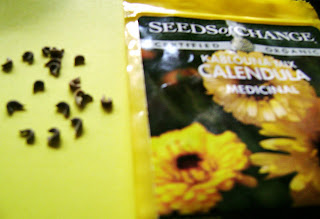
Last month I did a free seed starting demonstration at the store, which was well attended and everyone went home with a peat pot they had planted with calendula seed. I'm always amazed by calendula seed, it doesn't look like a seed at all, more like a dried up curled little worm. That this grows into a good size plant with those beautiful flowers is rather amazing. I also have some that I found when cleaning up the garden so planted them and hope to see some reseeding this year of the calendula. But back to seed starting...

While starting seeds isn't difficult, there are some things that ensure a good healthy seedling. The first thing I talked about was soil...a good soil starting mix is needed, not your soil from the garden or even a regular potting soil. I sometimes make my own mix with peat, but found a nice organic seed starting mix this year at my local organic garden supply store that seems to be working very well so far.

Second is light, seedlings need direct light and a lot of it. A good south facing sunny window is great. Since I don't have that, I use grow lights. There is all sort of discussion about types of light to use, but I've found a regular flourescent light works fine, for 12-14 hours a day.

Seedlings also need heat, and I keep mine protected against drafts. And although my grow stand is by a window, there is baseboard heat all along the wall, giving warmth from underneath.

One of the mistakes I find people often make is starting their seeds too early. Seed packets have a wealth of information, including how long it will take the plant to germinate and grow. I've learned not to start most of my seeds until March to avoid plants ready to go in the garden way before their planting time.

Then of course there is water. Seeds do not like to be dry, and are very unforgiving if not watered. I keep my seedlings consistently moist (not necessarily wet), watering several times a day if necessary. Yes this is a bit time consuming and needs to be paid attention, but I get so excited watching the seeds germinate and the seedlings grow that I check on them several times a day just for the fun of it anyways.

I fertilize with an weak strength organic seaweed and fish emulsion while their growing, which was also included in my soil mix along with some other natural nutrients.

Here are a few of my current seedlings, cucumbers on the left and zucchini just opening...


As the seedlings are nearing time to go into the garden, they need to gradually become acclimated to the weather outdoors, a process called "hardening off". There is nothing more discouraging than spending all that time growing a seedling and then having it die of shock when it is placed in the garden. I start by opening the window behind my plants for an hour a day and then gradually longer so they get used to the wind and small breezes. I then bring them outdoors to a protected area for more wind and then gradually into the sunlight acclimate to the sun. I do this over a week or two, not a long time but it really does help them become strong plants in the garden.

Or instead of doing all this, seeds can be directly planted in the garden and some prefer to be. Again, the seed package will tell which seeds start best in which manner but I find myself starting more plants directly in the garden every year. Make sure they are kept watered and I use HotKaps to protect the delicate seedlings from heavy rain or wind and also from insects.

So there's no excuse not to start plants from seed. It is economical and provides for a lot of choice in plants which may not be available otherwise. And just for the sheer awe that a small seed can become a plant to nourish our bodies and souls is reason itself. So happy seed starting!