Monday, March 2, 2015

The Plants - Florida Herbal Conference Part II


As I mentioned in Part I, the plants in Florida are much different than our New England plants.  Even across Florida there is quite a variety.  Florida is a large state, and ranges from Zone 8, where I live in the winter, to Zone 10 in southern Florida.  And there are coastal areas and inland areas, all having different micro climates.  So when talking about what grows, and how to grow, in Florida there is wide range of information.


The conference was in DeLeon Springs, which is north of Orlando and east of Ocala, just east of the Ocala National Forest.   The Ocala National Forest is the second largest nationally protected forest in the United States and covers 607 square miles of Central Florida.   It is the southernmost national forest in the US and protects the world’s largest contiguous sand pine scrub forest.  We drove through it to get to the conference and it is a beautiful and amazing place. 

In central Florida, we were able to see many blooming and growing plants at the end of February.  Some that I found interesting were:


Usnea – this is a picture of usnea growing on a broken limb hanging in a wild cherry tree and another of Jeanine holding it growing on a branch.   Usnea is a lichen and can be identified by the white thread that grows through it.  In central Florida, it grows most often on oak trees.   I have used dried usnea for urinary tract infections and it is also an immune tonic herb and high in Vitamin C.   I don’t recall ever seeing usnea growing in such profusion at home, it seemed to be just everywhere here!


Spanish Needle (Bidens Alba) – this is a common weed in Florida and in bloom in February.  The flowers and young leaves are edible and it is a great salad herb.  It can be used medicinally for colds and flu, inflammation and urinary tract infections.  I thought the cheery little flower was a wonderful sight and bidens is also the 3rd largest source of nectar for honeybees in Florida (behind saw palmetto and citrus fruit).


Gotu Kola (Centella erecta), sometimes called Pennywort – a cousin of Centella asiatica, these are so close that according to Green Deane only geneticists can tell the difference between the 2 species.  The picture is it growing right outside our tent by the lake, the gotu kola has the heart-shaped leaves.  While not native to North America, it is found in the southern part of the US and is thought to have been here for thousands of years.  In folklore, pennywort supposedly helped one Chinese master live to 256 years old.  Gotu kola is commonly used in Asian cooking and can be added to salads as well.  Medicinally, gotu kola increases memory and concentration, revitalizing nerve and brain cells.  It is also considered an adaptogen and is also antibacterial and antifungal.

Of course there were many more, some old familiars like plantain and elder and other new ones.  So many plants, so little time :-)


Florida Herbal Conference 2014 - Part I


I just returned from the Florida Herbal Conference held in DeLeon Springs this past weekend.   I had met Emily Ruff of the Florida School of Holistic living (who hosted the conference) at the NE Women’s Herbal Conference last summer and she talked about the Florida Conference and what’s better for someone from New England than to go to an herbal conference in February?   This is a fairly new conference - it was just their 4th year and they did a great job and it was a wonderful gathering.  I went with my daughter Jeanine and it was her first herbal conference so that made it even more special.


The conference was at Camp Winona, a Y camp on Lake Winona.  We pitched our tent next to the lake, and were treated by gotu kola growing wild right outside our tent door.  We ate a few leaves every morning to help with all the new things we were learning!  

I really enjoyed the weed walks as the plants in central Florida are very different than what we see in New England.  I went on a Medicinal and Edible walk with Juliet Blankespoor, who also gave an inspiring talk about bio-regional herbalism on Friday evening.  I had never seen usnea growing wild, or a long needle pine, or Spanish Needle (Bidens alba) to name a few.

On Sunday I went on an Eat the Weeds walk with Deane Jordan (Green Deane) and learned more about the differences in the plants in Florida from those in the Northeast.  Deane talked about the strength of stinging nettle in the south versus the northeast (MUCH stronger in the south) and that only the black (Sambucus nigra) elder grows naturally in Florida so no worries about toxic seeds.     Here's Deane holding up a stinging nettle with one of the thickest stems I have ever seen.


See more about the plants in Part II of the blog, Herbs at the Conference. 

On Saturday evening Stephen Foster was the keynote speaker and wove a wonderful story of the recent history of herbalism through his life experiences, from working at Sabathday Lake in Maine with the Shakers to his work with the Peterson Field Guides, all the books he has written and his work with the American Botanical Council.  It was interesting to reflect on how herbalism has grown and changed in the last 50 years and what our current challenges and opportunities are.   

And what is an herbal conference without Mz Imani drumming?  Even with pouring rain, the party with Mz Imani Saturday night had everyone dancing!  And she joined with Beautiful Chorus to make some amazing music during the entire weekend.


We enjoyed great food, wonderful teachers and workshops, friendly herbalists from all over Florida and the community that only a group of herb lovers can create over a few days.


And you know you've been to an herbal conference when the top of cars are used to hold plants.


Next year’s conference is February 26-28 with special guests Paul Stamets and Kathleen Maier.  Jeanine and I plan to attend, take a winter break and join us.  


Friday, December 19, 2014

Horehound Cough Drops


Don’t you just love it when what you need is there when you need it?  The universe at work.  My husband came down with this weird cough and I had just noticed that the horehound in the garden was still green and vibrant.  Not sure how that happened in mid-December where there has already been snow and freezing weather, but not getting around to cleaning up that part of the garden paid off.

So I made him some horehound cough drops, something I have always wanted to try.  They came out great, now I just need more people with coughs J  Here’s the recipe, if you have given them a try or have any tips, let me know.

Recipe:
There are many recipes for horehound cough drops and I decided to keep it simple with just horehound, ginger and honey:
Horehound – 2 cups fresh (or 1 cup dried)
Ginger – a small finger, peeled and sliced
Water – 1 cup water to each cup herbs
Honey – 3 cups (1 ½ cups honey to 1 cup “tea”)
Cream of tartar – ½ tsp


Steep the horehound and ginger in the water, I used 2 cups of fresh horehound to 2 ½ cups water, allowing for some water evaporation.  Let steep 30 minutes, strain.  I had a little over 2 cups of “tea”.   Add “tea” to a large pot and add the honey and cream of tartar.  


Boil until mixture reaches 300 degrees, use a candy thermometer to ensure the mixture reaches candy stage.  Grease a flat pan with sides with butter or use cooking spray.  Pour mixture into pan and spread out.  Let cool.


 To make the cough drops I tried 3 different methods – balls, cut squares and breaking the candy into pieces.

1.       Balls – When the mixture cools to a point where it can be handled, roll a small amount of mixture into a ball.  Grease hands with butter so avoid sticking.  You need to work fast as the mixture gets hard pretty quickly.  Place on wax paper to cool completely and harden.

2.       Squares – When the mixture cools to the point it is like salt water taffy, roll it out and cut with a sharp knife into squares.  Place on wax paper to cool completely and harden.  Of the 3 methods, I thought this was the easiest and came out the best.

3.       Break into pieces – while the mixture is in the pan and it has cooled to the taffy consistency, score the mixture into bite size pieces.  When totally hardened, remove from pan and break into pieces.  I found I could easily remove the candy from the pan but that it didn’t crack at all like I had scored it.  It was difficult to know the exact best time to score it, I tried at several points.  So this came out as chunks of cough drops.

Store the finished cough drops in an airtight container, I lined a tin with wax paper to store them.  This recipe made a lot of cough drops, probably at least 75 in various sizes (and chunks).  I’m not sure of the shelf life, will need to do some more research to figure that out.

A few tips from the experience:
The mixture boils up quite a bit, I had to change pots twice to allow it to boil rapidly enough to get to the high temperature and not boil over the sides of the pot.  So use a very big pot.

I’m not sure what the purpose of the cream of tartar is.  I thought it was to help keep the mixture from foaming when boiling, but I had quite a bit of foam when it boiled and still some when I poured it into the pan.  I tried adding some butter to the mixture to stop the foaming as that helps when making jellies, but it didn’t seem to make a difference either.

Get a candy thermometer.  I didn’t have one so had to do continually testing to see when it got to the candy stage and eventually just guessed.   It would have helped quite a bit.

Experiment, next time I will try adding some other herbs, maybe rosemary and/or thyme too?

Friday, October 17, 2014

Coriander Harvest Time


It's only recently that I started using coriander in my cooking and I've found out I love the flavor.  So this year I decided to harvest my own.

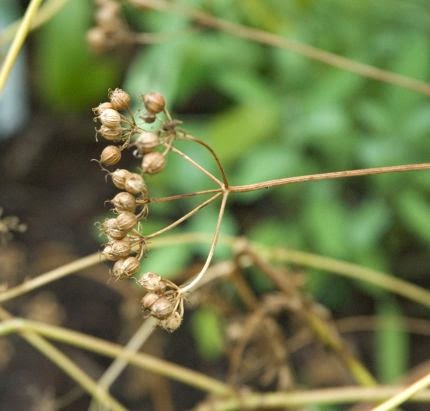
Coriander is the seed of the cilantro plant, Coriandrum sativum.  Lots of people don't know that they come from the same plant, and in the US we tend to call the green leaves cilantro and the seed of the plant coriander.  In England the leaves are called coriander also so if you have a recipe make sure you know whether it is referring to the leaf or seed.

So on this beautiful Fall day with the trees in all their glory I basked in the glow of the red, orange and gold shining on the garden and harvested the coriander.

In order to have the seeds you need to let some of your cilantro bolt and go to seed.  That's not difficult, and if you're like me the cilantro seems to bolt when I'm not looking!  So let a few plants flower and then the flowers will turn to seeds.  You want to make sure that the seeds are brown, as the picture above, not green when you harvest them.  The green seeds will be bitter and also contain too much moisture to store for any length of time successfully.

I like the paper bag method of harvesting seeds and use the same method for coriander that I do with dill.  Once the seeds are brown, I cut the stems and place them seeds and all in a brown paper sandwich bag.  You can use a larger brown shopping bag if you like or a plastic bag, whatever works for you.  I then shake the stems and the seeds pretty much just fall off.  For those that don't, I just rub them on the stem and they fall off.

Coriander seeds are small and easily drop all over the place.  I like to shake the stem just a little bit over the garden when I cut it so the seeds will self-sow for more cilantro plants next year.  The harvesting can be a bit messy so who knows where the cilantro will show up?

I also save a few seeds for planting next year, just in case the self-sowing doesn't happen but I usually find cilantro and dill popping up all over the garden in the Spring which I love.

So plan to harvest your own coriander next year!

Wednesday, January 29, 2014

World Wide Fire Cider Making Day Feb 2nd

I wrote the article linked below for Spirit of Change Magazine about the current controversy going on about the trademarking of the term Fire Cider.  In honor of this, a World Wide Fire Cider Making Day is being held Feb 2nd - make up a batch to help you through this cold winter! 

Click here to read the article:   Keep Fire Cider Free

Update:  Here is the Fire Cider my daughter and I made on Sunday for World Wide Fire Cider Making Day.  It was fun and came out great, need to let it sit for a few weeks and then we'll be drinking it up.  If you made some, share a pic!

Wednesday, August 7, 2013

Elderberry Harvest

One of the most frustrating things about trying to harvest elderberries I've found is that the birds get to the berries before I do!   I have several spots where I pick some of the elder flowers and then wait anxiously for the berries and then for them to ripen and then all hope is dashed when they are suddenly gone.

So I decided last year that I would plant my own elderberry in a new garden spot where I would try to keep the birds away.  So far it has worked and I picked the first of the berries today.

So how do you harvest elderberry?  Harvest ripened berries in August or September, they seem very early this year.  Ripened berries are purple or dark red, don't pick them when they are still green.  Clip the entire berry head on the stem right below the berries.

The berries need to be kept cool.  Strip them off the stem and place in the refrigerator.  The stems contain a gluey substance so you don't want stems in whatever you are making.  Removing the stems can be a very time consuming process.  Some people use a fork or comb, others freeze the berries first and the stems fall off - you will need to find what works best for you.  I do it the old fashioned way and just pluck them off.  Be careful not to crush the berries and lose the juice however.

 Keep the berries refrigerated and use immediately or the berries can be dried or frozen for future use.  Uncooked berries have a dark purple juice and are inedible and astringent - make sure to cook the elderberries before you ingest them.

My favorite use of elderberries is to make elderberry syrup, and if I can get enough berries this year I want to try making some elderberry jam.   Elder wine is a popular use also.  What are your favorite uses of elderberries?


Sunday, June 30, 2013

Lemon Balm

Lemon Balm!  It has been ages since I've added a new post, but a great workshop on lemon balm at the International Herb Symposium presented by Mimi Hernandez had such great information I just had to share.  I for one take my lemon balm for granted and often curse at it as it pops up all over the garden, never where I want it, and can easily take over a whole bed if I'm not careful.  So its easy to forget what a wonderful  herb this is and why it should be all over the garden.

I thought I knew a lot about lemon balm but as with all herbs, there is always more to learn.  The botanical name, Melissa, is Greek for honeybee.  I learned that lemon balm planted around bee hives keep bees happy, and also repels flies and mosquitos.

I often use lemon balm as an effective nervine for anxiety and sleep but learned that its relaxant properties are also helpful with hypertension, irritable bowel and colic. 

Research being done on lemon balm shows effectiveness in cognitive improvement and can be helpful with Alzheimers.

Lemon balm also helps with thyroid activity and is beneficial for hyperthyroidism.  There seems to be conflicting views about its effects on hypothyroidism, some say it has a negative effect by dropping TSH and others that it has a balancing effect on the thyroid and regulates it.  Seems like there needs to be more studies in this area.

And to top it off, lemon balm is antiviral helping with flu, measles, shingles and herpes.  A tincture can be made at a 45% alcohol level.  It has a relatively short shelf life so it was recommended that tincture be made fresh every year.

And check out Mimi's website and her One World Healing Community, www.mimihernandez.com.  She's a great teacher and a wealth of information.

Monday, September 3, 2012

Sage Mountain: The Shaman’s Path, Women Shamanism, Spirituality and Healing Plants


Just came home from Sage Mountain Herbal Retreat Center in Vermont after a weekend of a great workshop called The Shaman's Path.  Workshop doesn't seem like a big enough word to describe the weekend however.  We learned with wonderful healers and shamans Rocio Alarcon, Susan Ross Grimaldi and Maria Elena Martinez, a collection of 40 amazing women and of course, Rosemary Gladstar.

The magic of Sage Mountain is difficult to put into words.  I hadn't been back for a couple years and needed to just ground to the earth there again.  I was able to work with yarrow as a power plant this visit, learned to drum a bit and challenged myself to participate in activities outside my personal comfort zone. 

And there was such laughter and good friends made.  It was a group of women in the best sense, which sometimes doesn't happen.  Strong, independent, open, honest, vulnerable, healing, sensitive, loving, giving, kind and searching - it was quite a group as we all shared and learned from each other.

I was enthralled with Susan Ross Grimaldi's work in Mongolia and China documenting and helping re-institute the ancient history of shamanism there (see more about Susan on her website  http://susangrimaldi.com/).  Her words on personal power touched deep inside and the responsibility that personal power invokes in the healing process.  And through her talk on Shaman Chants, finding my own personal song (thanks to my workshop partner and friend Linda helping with this), which we all have inside us, just waiting to get out.

Rocio Alarcon brought her work from Ecuador and the Amazon rain forest as well as the Basque country in Spain to work with us on spiritual cleansing and healing through water.  A very special evening healing water ceremony under the full moon in the clean, cold Vermont water on that magical piece of earth was transforming.   I was especially blessed to be Rocio's partner in this ceremony, an extra added bonus.

And as we talked about herbs used in the shamanic process and did energy healing with the plants, I'm forever amazed and grateful of the healing bounty that is all around us.  We asked for healing for women around the world who are suffering, oppressed, violated, and marginalized, sending the healing of the plants and recognizing the shaman in each of us in the process.   May we all be thankful for what we have and who we are, and use that in going out into the world to foster healing, kindness, peace and love.


Tuesday, August 21, 2012

Aack, It's a Groundhog!

I knew I was in trouble the other day when one of my big, beautiful but still green tomatoes was missing the whole side.  Someone took a bite right out of it hanging on the plant and left it there, half eaten.  Guess it wasn't ripe enough.

So as I'm eating lunch today looking out at the garden, 'Phil' goes lumbering across the garden, briefly looking at me sitting inside.  As I jump up and get my camera and sneak to see where he is going, he munches on some parsley and then strolls past the nasturium towards the gate.  In no hurry, but guess he wasn't too hungry because he didn't seem to eat anything else.  Here he is above, unfortunately the echninacea was in the way to get a good shot of his head, but that rolly polly body and bushy tail give it all away!

So if he's strolling around in the middle of the day, I know he has found my little garden and I have a battle on my hand.  Guess I know where the chard went.  I read "The $64 Tomato" a few summers ago and laughed outloud at the chapter about the groundhog, but I guess I'm not laughing now.

AAAHHH, so NOT want I want to deal with in the garden.

Tuesday, July 10, 2012

Garden in the Woods

Visited Garden in the Woods today in Framingham.   It's been too long since I've been there and it was beautiful as always.  I'm starting a new garden area at the end of the driveway and want it to look natural, like it would have come right of the woods.  I got some wonderful ideas, and plants.  Here are some highlights:

King Solomon Seal, Polygonatum biflorum, yes, much larger than the ones home in my garden.

Goldenseal, with the berries just starting to form in the crux of the leaf.  I love how it does this.  The garden had multiple areas in the woods with stands of goldseal, so nice to see this powerful plant thriving in such abudance.


Paris quadrifolia, I'm not at all familiar with this and loved the blue berry on the top.  Will need to look it up, anyone know this one?

The garden has a collection of pitcher plants, these in a little island in the pond were my favorites.

American Ginseng, Panax quinqufolia.  Another plant so nice to see thriving in our area.

I loved this view of the Mayapple, Podophyllum peltatum, showing the little fruits starting to form under the leaves.

Cool horsetail, not quite sure what species Equisetum but I asked at the info center and they said it was scouring rush.  Need to research, loved the colors.

Great St John's Wort, Hypericum ascyron.  I've never seen this large variety before, striking!
And there was so much more, a garden well worth visiting many times.

Saturday, May 26, 2012

Memorial Day Blooming

I've never seen Memorial Day weekend blooming like this at the store, and it is wonderful.  While we might typically have the chives blooming, they are almost past and I haven't even made any chive vinegar yet.  The sage is gloriously in full flower and the yarrow flower started opening yesterday, a full 3 to 4 weeks early.  The garden is just briming, not sure what will be left in a month or two, but maybe we'll get some second flushes of flowers this year. 

The garden is overtaken with feverfew this year also, which I love but enough already.  It is budded and ready to open soon, and as soon as it flowers it will get picked and dried and the plants removed to avoid a total feverfew garden next year.


Wednesday, January 11, 2012

Tea Adventure

Visited the prettiest tea house yesterday for Ladies Lunch Out here in Florida.  The Glass Slipper Tea Cottage is in Fort Walton Beach, FL and absolutely charming.  The food is delicious, the teas (Harney & Sons) delicious and I had to smile when they brought out pots of Hot Cinnamon Spice tea, one of our bestsellers at the store.
 We all got to put on hats, and there was a tray of tea cups where we chose our own cup.  This display of tea pots from around the world was so pretty!  The food was wonderful with delicious scones, savories, and desserts served with clotted cream and lemon curd  They had a nice cookbook which of course I bought.

And I learned about cheese straws.  I was told in the South, every shower and event has cheese straws and they are delicious.  Got the recipe for that and will have to try it.

Here are the ladies, what a wonderful outing (I'm in the back on my toes, you can see my big beige hat just peeking through!).


Thursday, December 1, 2011

Angelica 'Break-through"


It has been said by some that it is better to know a few plants well than many plants superficially. Angelica is one of those that has fascinated me over the past couple years, and never fails to impress me and surprise me. From it's amazing size summer before last, to the many, MANY volunteer plants this summer it is beautiful and dramatic.
The Fall however brings another whole facet to the plant. The weather has gotten cold and just when you think it should be quietly dying back getting ready for winter, new growth literally bursts forth from this plant.
You may need to enlarge the picture to see how the thick, hollow stem splits right open up the middle as a new stem with leaves bursts forth. It looks like someone has taken a knife to the stem of the plant, but they are all exploding with growth at this time when everything else is faded.
So as I trim back all the growth in anticipation of the winter weather right around the corner, I can't help but leave these new stems bravely reaching out. I find it just incredible, and never get tired of watching and learning about this plant.

Friday, August 12, 2011

Herb Competition

I've never entered a competitive show before, but with the New England Unit of the Herb Society of America having their second annual Competitive Herb Show next door at Tower Hill Botanic Garden, I had to give it a try. I found myself rather nervous bringing my entries in last night, we'll see what the judges say!

The picture above is my Fragrant themed container. It has five plants - Pineapple Sage (salvia elegans), Banana Mint (Mentha arvensis), white flowering Rosemary (Rosmarinus officinalis 'alba'), Lavender (Lavendula angustifolia 'Munstead') and a chocolate peppermint scented geranium (Pelargonium 'Chocolate Peppermint').

This is the Lemon Delight container with Lemongrass (Cympopogon citratus), Lemon Verbena (Aloysia triphylla), Lemon Savory (Satureia biflora), Lemon Balm (Melissa officinalis) and Lemon Thyme (Thymus citriodorus). It was hard to get this in the car and to the show without bending the lemon grass - it grew awful tall!

And the third container submission was a single specimen of Lavender, Lavendula angustifolia 'Ellagance Sky'. Ellagance Sky has a beautiful shape and also a unique lovely light violet blue flower. I made sure to take one for myself when they came into the store this Spring as I knew they would sell quickly.

I also submitted two items into the Cut Stem, Medicinal, category - Boneset (Eupatorium perfoliatum) and Horehound (Marrubium vulgare). This was tricky, because I don't think I had a stem in the garden that didn't have at least one leaf with a hole or discoloration. But I picked the best I could find.

So if you get a chance to go to the show this weekend at Tower Hill, see if you can spot my entries and hope the judges are kind. I'll add a post how it turned out!


Tuesday, June 21, 2011

Foxglove Frenzy

I just love foxglove (Digitalis purpurea). There is all kinds of folklore around foxglove and other common names are Fairy Gloves, Fairy Thimbles, Witches' Gloves and Dead Men's Bells. It
was originally Folksglove as the flowers resemble the fingers of a glove.Foxglove contains cardiac stimulants, the most familiar being Digitoxin. It is extremely poisonous and should not be used internally.

So just enjoy these wonderful plants. They come in all colors and Digitalis grandiflora, the big-flowered foxglove, is a brilliant yellow. The above picture is Digitalis mertonensis, or Strawberry Foxglove, which is a cross of Digital purpurea and Digitalis grandiflora that I am enjoying in my garden this year.


Saturday, June 18, 2011

Angelica Angst

Aargh!! What is happening to the angelica? I think it is a gourmet groundhog that only eats angelica? This is what was a good size 2nd year angelica at the store that I was looking forward to flowering this year. In one day, all the leaves were gone, obviously munched away. This plant is surrounded by other herbs, none of which have been touched.

The mystery actually started last week, when the seedlings from last year's beautiful angelica (see the post on that from last summer) filled the garden. They were thinned out and I left a number of them in place to mature. One day, I went out and the leaves were chopped off the seedlings, about every other one. What was up with this?
It was a few days later that the 2nd year angelica at the store was someone's dinner. Did Angelica Alice or Al like the small ones so much they went looking for larger leaves? I have never seen an angelica bothered by any type of animal or insect. Anyone have any ideas or seen this before?
So here is the picture of last year's angelica in June. No hope of that in either garden this year. Maybe if I can protect some of the seedlings we can look forward to next year and Angelica Alice will have to find something new to eat!

Monday, May 16, 2011

Scotland - Part I

Scotland - land of castles, water, mountains, rock...we just returned from a wonderful trip. There were so many wonderful things but here are the "garden" pictures.


Well not exactly garden, I was fortunate to be able to visit for a 2nd time the standing stones of Callenish on the Isle of Lewis in the Outer Hebrides. Thousands of years old, no one is quite sure who put them there, or why. Experts are pretty sure it is a lunar alignment, and the area is scattered with them. They fascinate and move me, quite extraordinary.


The land was ablaze in yellow for our visit. The gorse was everywhere. This was taken from the top of Dunnideer Hillfort, the site of an ancient Roman castle.


And more yellow came from the fields of rapeseed. I had a delicious rapeseed oil one night for dinner with fresh bread. Heavier and a bit nuttier than olive oil, it is flavorful and grown all over.


The Highlands are stark, rocky and breathtakingly beautiful, with gorse here in bloom again.


On the Isle of Skye, we visited the "fairy land". I can believe fairies live among these rocks and this tree that seemed to grow right up out of the rock.


A wonderful moss wall on a country road in Insch. It was a beautiful trip, I hope to visit again.